Everyone I Know Seems Richer Than Me. Then I Looked Up the Average Net Worth by Age.
 By IlY · Jul 24, 2026 · 6 min read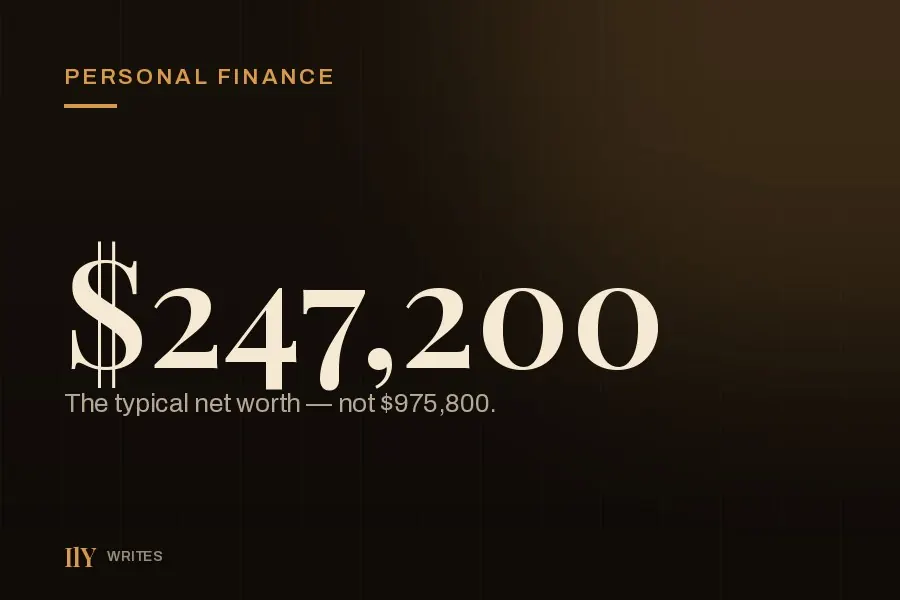
The “average” for my age bracket is nearly a million dollars. The typical person my age has a quarter of that. Both numbers are true, and the gap between them explains almost everything about why you feel behind.
A friend mentioned, very casually, over dinner, that he’d “finally gotten the emergency fund sorted.” Six months of expenses. Said it the way you’d mention getting your car serviced.
I nodded like a person who also had that.
I did not have that. I had maybe seven weeks if I stopped eating out, and I’d spent most of the previous year assuming that was roughly normal for someone my age, in my job, in this economy. His tone suggested otherwise. His tone suggested six months was the baseline, the boring minimum, the thing you sort out before moving on to the real stuff.
I went home and did what everyone does at eleven at night after a conversation like that. I looked up the average net worth for my age.
The number that came back was $975,800.
I sat with that for a while.
The number was real. It was also almost meaningless.
Here’s what I didn’t know that night, and what took me an embarrassing amount of reading to understand.
There are two numbers. Every source publishes them, but almost every headline, video, and viral chart uses only one of them, and it’s the wrong one.
The average (the mean) adds up everyone’s net worth and divides by the number of people. The median lines everyone up from poorest to richest and takes the person standing exactly in the middle.
For most things these two numbers are close. Height, for instance. The average adult height and the median adult height are basically the same, because there’s no one out there who’s four hundred feet tall dragging the average up.
Wealth has people who are four hundred feet tall.
Here’s what that does, using the Federal Reserve’s most recent Survey of Consumer Finances:
Look at the 45–54 row. The average is $975,800. The median is $247,200. The average is nearly four times the typical person.
That’s not a rounding difference or a statistical quibble. It means that when someone tells you the “average person your age” has almost a million dollars, they are describing a person who does not exist. They’re describing an arithmetic artifact created by a small number of extremely wealthy households sitting at the top of the distribution and pulling the mean up like a hand on a scale.
The person in the actual middle has a quarter of that.
The number that should have made me feel worse made me feel enormously better
I want to be honest about the emotional experience here, because I think it’s the actual point.
Reading “$975,800” at eleven at night made me feel like a failure. Not in a dramatic way. In the quiet way where you close the laptop and go to bed and there’s a low hum of something in your chest.
Reading “$247,200” a few days later, once I understood what I’d been looking at, did something completely different. It didn’t make me feel rich. It just made me feel located. Like I could finally see where I actually stood instead of where I imagined I stood relative to a phantom.
And here’s the thing that surprised me: the median numbers are, for most people, genuinely reassuring. Median net worth under 35 is $39,000. That’s a real number for real people, and it includes home equity and retirement accounts and everything else. If you’re thirty and you have $20,000 and you’ve been quietly assuming everyone else your age has six figures, you are not as far behind as the internet has led you to believe.
You’ve been comparing yourself to an average that’s mathematically incapable of describing a normal person.
Why nobody publishes the useful number
The obvious question is why the mean gets used everywhere when the median is more informative.
Some of it is genuinely innocent. “Average” is the word people know. Median requires a sentence of explanation, and headlines don’t have a sentence to spare.
But some of it isn’t innocent, and it’s worth naming. The mean is a better number for anyone selling you something. A financial product, a course, an app, a newsletter, a coaching program. If the typical person your age has $247,200, you might reasonably conclude you’re doing fine and go about your life. If the “average person your age” has $975,800 and you have $60,000, you are a person with a problem, and people with problems buy solutions.
The gap between those two numbers is, commercially speaking, a business model.
I don’t think there’s a room somewhere where this gets decided. It’s just that the more alarming number performs better, gets clicked more, converts better, and so it survives and the accurate one doesn’t. Nobody has to conspire. The incentive does the work on its own.
The friends thing
The part I keep circling back to is my friend and his six-month emergency fund.
A few months after that dinner, in a different conversation, it came out that a chunk of it had come from an inheritance. Not a large one. But enough that “finally got the emergency fund sorted” meant something quite different from what I’d heard at the table.
He wasn’t lying. He didn’t owe me his balance sheet over pasta. He said a true thing in a normal way and I filled in the rest with a story where he was disciplined and I was behind.
That’s what I actually did wrong that night. Not the googling. The story.
Because nobody at that table said “I have $180,000 in student debt” or “my parents covered my deposit” or “I’ve been carrying a credit card balance for four years.” Those are the sentences that don’t get said. What gets said is the sorted emergency fund, the new car, the holiday, the promotion. The visible surface of everyone’s finances is a highlight reel, and then on top of that reel we lay an average number that’s been distorted by billionaires, and then we wonder why we feel like we’re failing at something everyone else has figured out.
Almost everyone I know is somewhere between “fine” and “quietly stressed about money.” Including the ones who look like they aren’t. I only know that because I got old enough that a few people started telling the truth.
What I’d actually do with these numbers
Not much, honestly, and I think that’s correct.
Knowing the median for your age is useful exactly once. It calibrates you. It tells you whether the vague dread you’ve been carrying is proportionate. For most people it turns out to be wildly disproportionate, and that’s worth knowing.
After that, the number stops being useful, because you are not the median and you were never going to be. Your situation has your specific salary, your specific debt, your specific city, whether your parents helped, whether you got sick, whether you had kids, whether you started late. The median doesn’t know any of that. It’s a rough position marker, not a scorecard, and treating it as a scorecard just swaps one flavour of comparison anxiety for another.
The only genuinely actionable thing I took from all of it is this: your net worth trajectory matters and your net worth position mostly doesn’t. Whether it’s higher than last year. Whether the debt is shrinking. Whether anything is being invested at all. Those are the levers you actually have.
The one number I actually track now
I stopped tracking my net worth against my age bracket. It was making me miserable and it wasn’t informing a single decision.
I track one thing instead, which is whether the number went up compared to twelve months ago. That’s it. Up is good. Flat means something needs looking at. Down means something needs looking at urgently.
It’s a much dumber metric and it has been far more useful, mostly because it’s the only one that responds to anything I actually do.
The average net worth for my age is $975,800 and I will probably never see it. The median is $247,200 and I’m somewhere in the neighbourhood, which apparently makes me painfully normal, which after that dinner was all I really wanted to know.
Money is a skill. Learn it.
Get the weekly letter and the first chapter of the book — free.
Get it free →


Join the conversation
Comments are powered by Disqus.